

Most businesses know something is wrong with their brand before they know what. The logo feels dated, the website makes you wince a little when you send the link, and the van, the business card and the Instagram grid look like they belong to three different companies. What is harder to work out is whether that means a tidy-up or a fresh start - and the gap between the two is roughly five times the budget. Rebrand or refresh: here is how I tell the difference, what each one costs, and the part of the bill most people forget until it arrives.
Rebrand or refresh: the difference in one line.
A refresh keeps the name and the recognition you have already built, and modernises everything around them. A full rebrand goes back to the thinking first - who you are for, what you are called, what you actually sell - and builds a new identity from there. The test is not how dated the logo looks. It is whether the brand still tells the truth about the business.
The question that decides it.
If a customer from three years ago looked at your brand today, would any of it mislead them? If the answer is no - same work, same sort of customer, same name, and it has simply aged badly - that is a refresh. The brand is still accurate, it has just stopped looking like it belongs to this decade. If the answer is yes - you have changed what you sell, who you sell it to, or what you are called, and the brand is quietly describing a business that no longer exists - that is a rebrand. No amount of better typography fixes a name that is wrong.
When a refresh is enough.
You are probably in refresh territory if the name still fits, customers find you by it, and the real problem is execution rather than meaning. Typically that looks like a logo drawn quickly in year one and never revisited, colours that have drifted because nobody ever wrote them down, three different fonts across your paperwork, or a perfectly decent identity with no rules attached to it.
A refresh keeps what people recognise - often the core of the logo, usually the colour customers associate with you - and rebuilds everything around it properly. Cleaner marks, a palette that works in print as well as on screen, a type system, and a set of brand guidelines so it stays consistent long after I hand it over.
When only a rebrand will do.
You need the full thing if the business has changed direction, merged, outgrown its name, or if the name was never right to begin with. The giveaway is usually that you find yourself explaining the name to people - if every new customer needs a sentence of context before it makes sense, the name is costing you work. Shire Sand & Gravel is the clearest example I have. Shire Contracting did general contracting, so when the business moved to supplying sand, gravel and grab hire, the name stopped describing the work and customers searching for aggregates had no reason to think it was them. That was never a logo problem.
What each one costs.
Everything is a fixed quote agreed before any work starts, and there is no VAT to add. A refresh usually lands in one of two packages. Logo Design is £450, which covers a discovery questionnaire, two concepts, two rounds of revisions and a full file pack for print, web and single colour. Brand Identity is £1,250 and adds a logo suite, colour palette, typography, a six-page brand guide, business card design and three social media templates. A full rebrand starts at £2,500, which includes a strategy workshop, the full identity, twenty-page brand guidelines, stationery, signage or van artwork, and launch assets.
The cost everyone forgets.
Design is the smaller half of a rebrand. The roll-out is the rest, and it is the part that catches people out. Signage and vehicle artwork starts at £200, but that is the artwork only - printing, stock and fitting are paid to your sign maker or fitter. Then there is workwear, reprinted stationery, and the website, which runs from £750 for a landing page to £2,950 for a ten-page business site.
Here is the part worth knowing before you commit. A refresh can be phased: update the website now, replace the van graphics when the lease is up, use the last of the old business cards. A full rebrand mostly cannot. A business halfway through a rebrand looks less trustworthy than one that never started, because customers see two identities and assume something has gone wrong. If you are doing the full thing, budget to change the visible items together.
How long it takes.
A refresh can be done in a few weeks. A full rebrand with naming and a new website takes considerably longer, and every project gets an agreed timeline before any work starts.
The variable is almost never the design. It is how quickly decisions get made and who has to sign them off. A business with one decision-maker moves at roughly twice the speed of one working through a committee, and naming is the step that stretches most, because it has to clear a domain check and sound right said out loud as well as look right on a van.
Two honest warnings before you spend anything. Do not rebrand to fix a sales problem - if the work or the pricing is the issue, a new logo just makes the same problem look smarter.
And do not refresh something that needs replacing. It is the more expensive mistake of the two, because you pay for the tidy-up and then pay again for the rebrand inside two years.
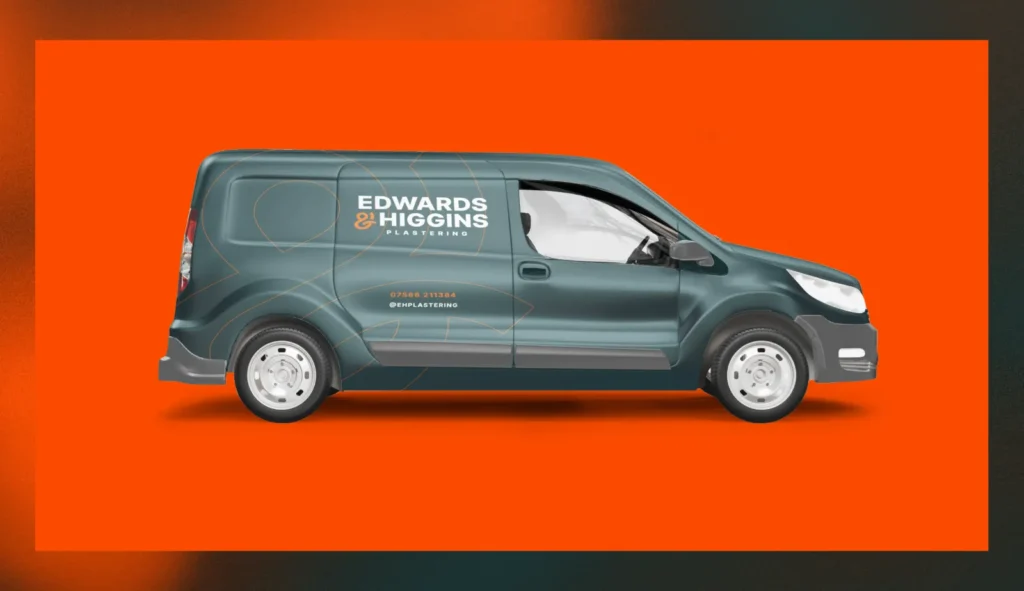
Edwards & Higgins is a good example of the other direction - a plastering team whose work already spoke for itself and whose name was never the problem. What it needed was a wordmark confident enough to hold up on a van door and on hi-vis, not a new identity.
If you are somewhere in the middle, say so when you get in touch. Working out which one you need is the first conversation, not an extra, and I would rather tell you a refresh will do than sell you a rebrand you do not need.
Based in Grimsby, working with businesses across North East Lincolnshire. You can see the full rebranding service, or browse my work to see how refreshes and rebrands look side by side.
One last practical note: whichever way you go, get the files. A proper handover includes vector artwork, single-colour versions and the fonts, so you are never locked out of your own brand by a designer you no longer work with. And if the change involves your registered company name rather than just a trading name, that is a Companies House job as well as a design one - you can do it through GOV.UK.